In this article, we will learn about the Electron Theory of Matter and Atom, which is an important concept of electrical engineering. The electron theory of matter is the outcome of the research work of various physicists and electrical scientists. This theory explains how electricity comes into existence.
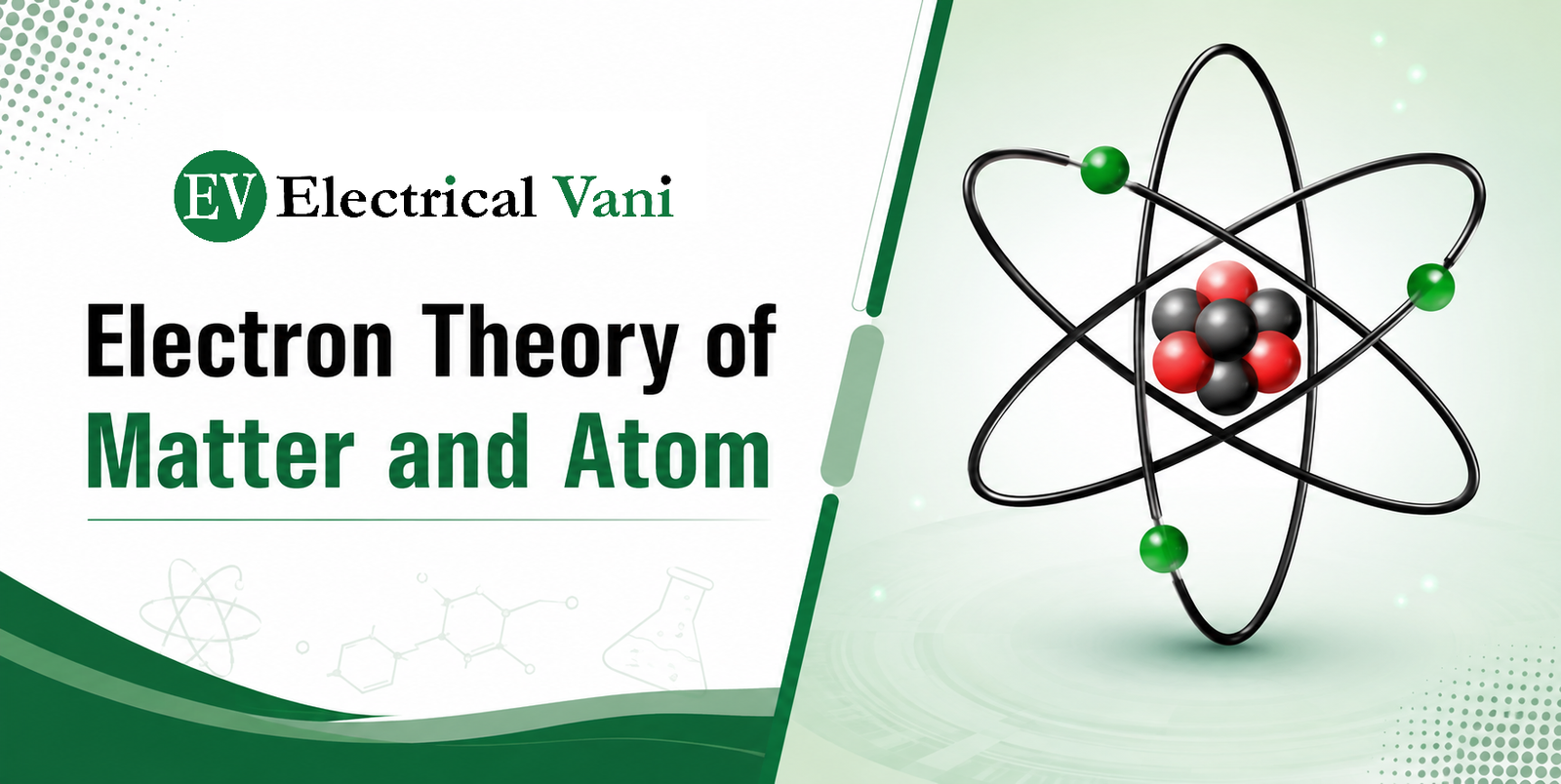
What is Electron Theory of Matter?
Electron Theory of Matter states that all materials/substances, including solids, liquids, and gases, are composed of minute particles called molecules, where molecules in turn are made up of atoms.
According to this theory, all matter or substances can be classified into Elements and Compounds as follows –
- Substances whose molecules consist of the same type of atoms are called elements.
- Substances whose molecules consist of different types of atoms are called compounds.
What is Atom?
An atom is the fundamental building block of all matter/substances. It consists of a central part called the nucleus, and around the nucleus, it has a number of electrons revolving in different orbits. This outer part is called the extra-nucleus. An atom has a diameter of the order of 10-10 m, while the diameter of the nucleus is of the order of 10-15 m.
Thus, an atom has the following two main parts –
- Nucleus
- Extra-Nucleus
Nucleus
As stated, the nucleus is the central part of an atom. It contains two subatomic particles named Proton and Neutron.
A proton is a positively charged particle whose charge and mass are given below.
$$\text{Mass of Proton }(M_p )=1.67×10^{-27}\text{ kg}$$
$$\text{Charge on Proton }(Q_p )=+1.6×10^{-19}\text{ C}$$
On the other hand, a neutron has no charge/zero charge. The mass of a neutron is given below –
$$\text{Mass of Neutron }(M_p )=1.67×10^{-27}\text{ kg}$$
It can be noted that the proton and neutron have equal mass.
From the above discussion, it is clear that the nucleus of an atom bears a positive charge.
It is also important to note that the mass of an electron is very small compared to that of a proton or a neutron. Therefore, the nucleus of an atom constitutes the entire weight of the atom. Thus,
Atomic Weight = No of Protons + No of Neutrons
Extra-Nucleus
In an atom, the space around the nucleus is called the extra-nucleus. It contains electrons only.
An electron is a negatively charged particle whose charge and mass are given below.
$$\text{Mass of Electron }(M_e )=9.1×10^{-31}\text{ kg}$$
$$\text{Charge on Electron }(Q_e )=-1.6×10^{-19}\text{ C}$$
The electrons present in the extra-nucleus revolve around the nucleus in different orbits by following the rules given below –
- The maximum number of electrons that an orbit can have is given by 2n2, where n is the orbit number. For example,
- 1st orbit electrons = 2 x 12 = 2
- 2nd orbit electrons = 2 x 22 = 8
- 3rd orbit electrons = 2 x 32 = 18, and so on.
- The last orbit in an atom cannot have more than 8 electrons.
- The last but one orbit cannot have more than 18 electrons.
Under normal conditions, an atom has an equal number of electrons and protons. Therefore, an atom is neutral as a whole in normal conditions.
The number of protons in an atom is called its atomic number, i.e.
Atomic Number = No of Protons
The electron theory of matter also defines the nature of electricity as discussed below.
Nature of Electricity
As per the electron theory of matter, we have the following three points explaining the nature of electricity –
- If the number of protons is equal to the number of electrons in a body. The net charge on the body is zero. The body is said to be electrically neutral.
- If some electrons are removed from a neutral body, there will be a deficit of electrons/negative charge. The body will attain a positive charge.
- If a number of electrons is supplied to a neutral body, there will be an excess of electrons/negative charge. The body is said to be negatively charged.
In the above explanation, we observed that we are either removing or inserting electrons, not moving protons. This is because –
- Electrons have a very small mass and higher mobility.
- Protons are powerfully bound in the nucleus and cannot be moved easily.