In this article, we will learn about the Mechanism of Current Conduction in Metals. Here, we will learn how electric current flows in metallic conductors. As we know, electric current is defined as the flow of electric charge or electrons in a conductor, while a conductor is nothing but a material that allows electric charge to flow. Let’s understand the flow of electric current in metallic conductors.
How is the Current Conducted in Metals?
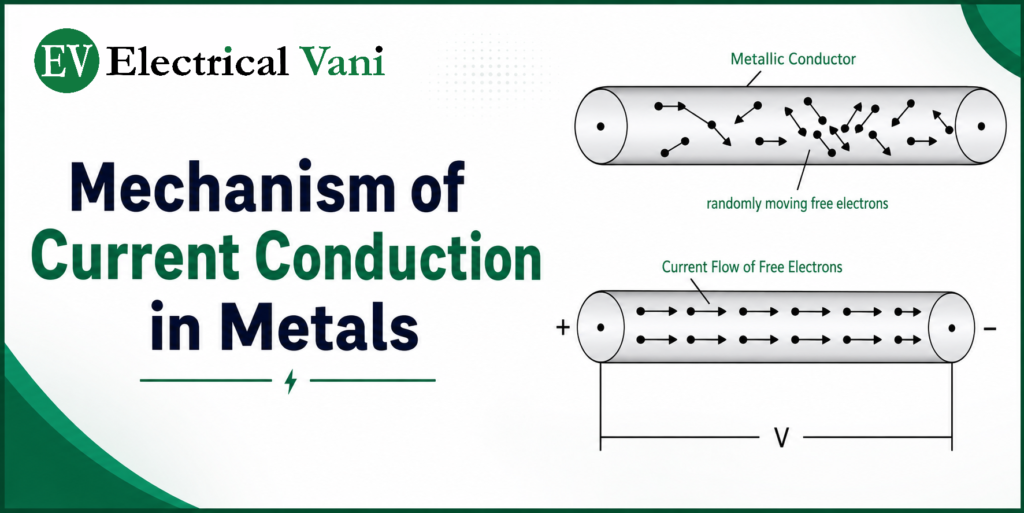
From basic science, we know that every metal or metallic conductor has a large number of free electrons, and these free electrons move randomly within the body of the metallic conductor, just like molecules in a gas.

It is experimentally proven that the average velocity of these free electrons, at room temperature, is very high, around 105 ms-1.
When the free electrons move randomly, they repeatedly collide with positive atoms of the metallic conductor. After each collision, their direction of movement changes.
When all free electrons of the conductor are considered at the same time, their random motion averages to zero. In other words, there is no net movement of electric charge or electrons in a specific direction. As a result, there will be no current through the conductor.
Now, when we apply a voltage or potential difference across the ends of a conductor, an electric field is established at every point of the metallic conductor. This electric field applies a force on free electrons, due to which they start accelerating towards the positive terminal of the applied voltage source.

When the free electrons move, they collide again and again with the positive atoms of the metallic conductor. On each collision, the extra velocity gained by the free electrons is destroyed. However, free electrons are continuously accelerated by the electric field, and collisions prevent their velocity from becoming large.
As a result, the applied electric field provides a small constant velocity to free electrons towards the positive terminal. This constant velocity of free electrons is called drift velocity.
The drift velocity of free electrons is of the order of 10-5 ms-1.
Hence, this is all about current conduction in metallic conductors.