In this chapter, we will learn about DC Motor Working Principle (Operation of DC Motor). As we know, DC motor is an electromechanical energy conversion device that covers direct current electricity into rotational mechanical energy which is then used to drive mechanical loads.
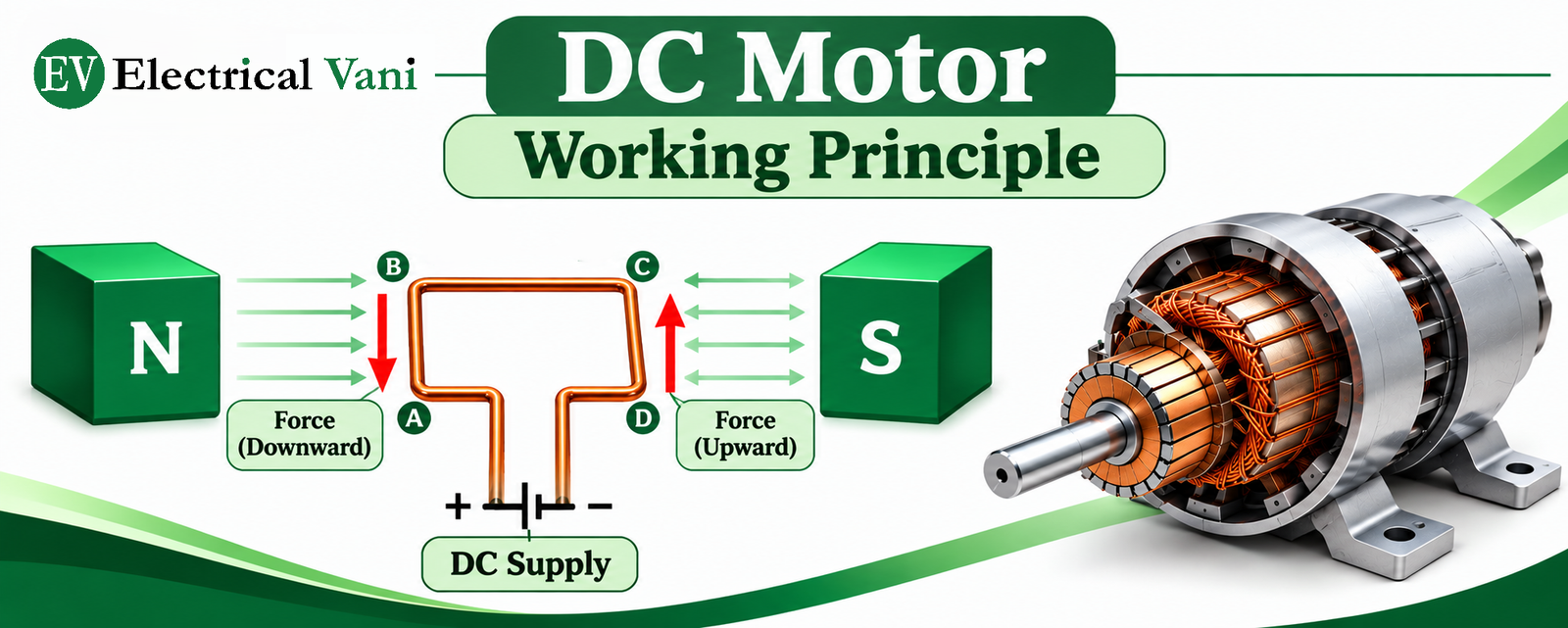
Fundamentally, the working or operation of a DC motor is based on the interaction between a magnetic field and a current-carrying conductor. Let’s discuss this concept in detail.
Theory of Working Principle of DC Motor
The working of a DC motor is based on the fundamental principle of electromagnetism. According to this principle. A current-carrying conductor placed in a magnetic field experiences a mechanical force, which can move it.
To understand the working of a DC motor, let us consider a rectangular coil ABCD which is placed between the North (N) and South (S) poles of a magnet as shown in the following figure.
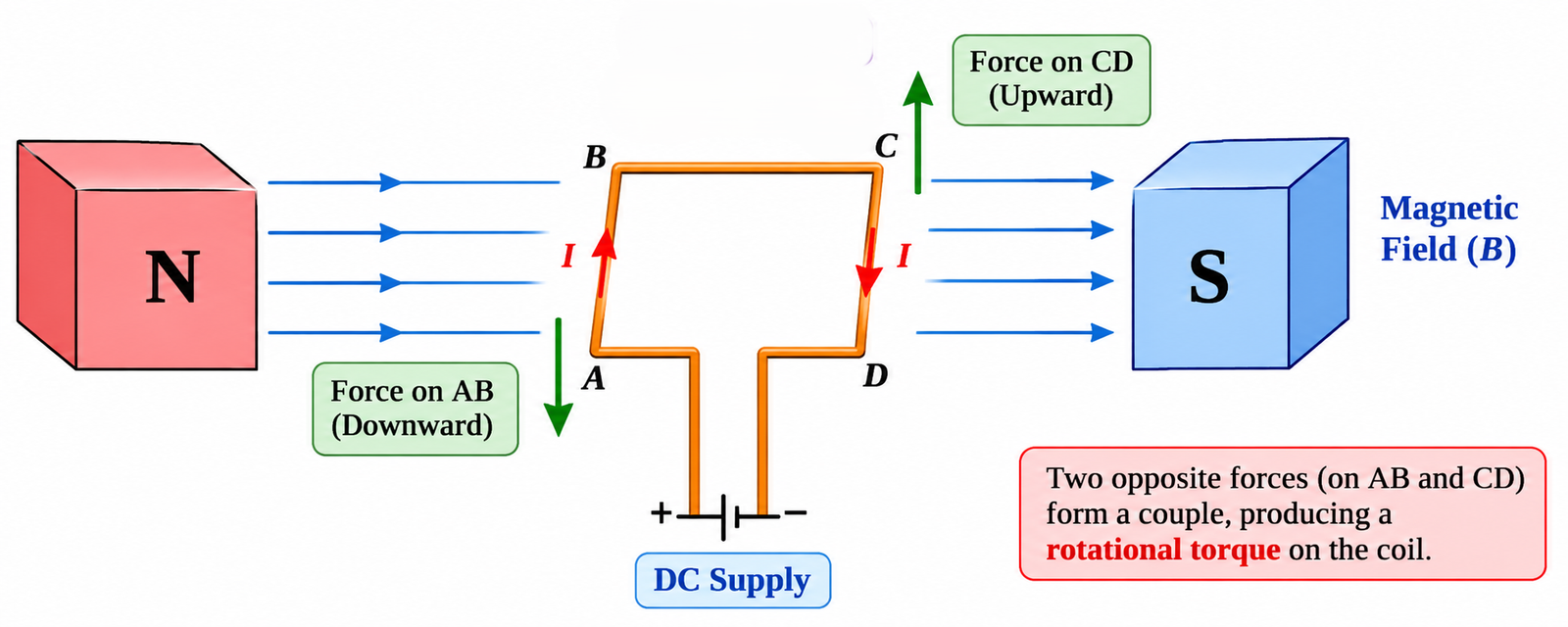
When a DC voltage is applied to this coil, an electric current starts flowing through its conductors.
The magnetic field is in the direction from the North pole to the South pole as shown in the figure. Therefore, due to interaction between current and magnetic field, the two opposite sides of the coil i.e., AB and CD experiences mechanical forces in opposite directions, (direction of force can be determined using Fleming’s Left Hand Rule).
In the given coil-magnet arrangement, according to Fleming’s left hand rule, force will act as follows:
- Coil side AB experiences a downward force.
- Coil side CD experiences an upward force.
Hence, these two forces form a force couple and produce a rotational torque, and results in rotation of the coil. The continuous interaction between the magnetic field and current in the coil maintains the rotational motion.
Formula of Mechanical Force Produced in DC Motor
It is experimentally observed that the electromagnetic force acting on the current-carrying conductor is proportional to –
- Magnetic flux density (B)
- Current flowing through the conductor/coil (I)
- Effective length of the conductor (L sinϑ), as the component of the conductor perpendicular to the magnetic field contributes to the electromagnetic force. ϑ is the angle between coil and magnetic field.
Combining the three statements, we get,
$$F∝BIL sinθ$$
In SI units the constant of proportionality is 1. Therefore,
$$F=BIL sinθ$$
|
Position of Conductor (Angle) |
Electromagnetic Force |
| Perpendicular to magnetic field (90°) | F = BIL (maximum) |
| Parallel to magnetic field (0°) | F = 0 (minimum) |
| Inclined at 30° | F = BIL/2 (half) |
Operation of DC Motor
Let us now understand how does a DC motor work when a DC supply is provided to its terminals? The following is the step-by-step explanation of DC motor operation –
Step 1 – Production of magnetic field:
In DC motor a static magnetic field is produced either by permanent magnets or a field winding.
Step 2 – Flow of armature current:
The armature winding is connected to an external DC supply through an arrangement of commutator and brushes. This results in flow of current in armature conductors.
Step 3 – Production of electromagnetic force:
Now, the current-carrying armature conductors are placed in a magnetic field. According to Fleming’s left hand rule each armature conductor will experience a mechanical force in a specific direction.
Step 4 – Development of rotational torque:
The forces acting on armature conductors form force-couple and produce electromagnetic torque in the armature. When this developed electromagnetic torque becomes greater than opposing load torque and frictional torque, the armature starts rotating.
Step 5 – Commutator action:
The commutator performs reversal of current direction in rotating armature after every half revolution. This is important to maintain the torque in the same direction.
Step 6 – Continuous rotation:
The continuous DC supply and production of electromagnetic torque maintain the rotation of the armature and conversion of DC electricity into mechanical energy.
Hence, this is all about working principle of DC motor.