In this chapter, we will learn about the difference between AC and DC. Alternating Current (AC) and Direct Current (DC) are two main types of electric current we use in a variety of circuits. This chapter explains all the major differences between alternating current and direct current considering all the key factors of comparison such as definitions, working principles, examples, comparison table, advantages, disadvantages, and applications.
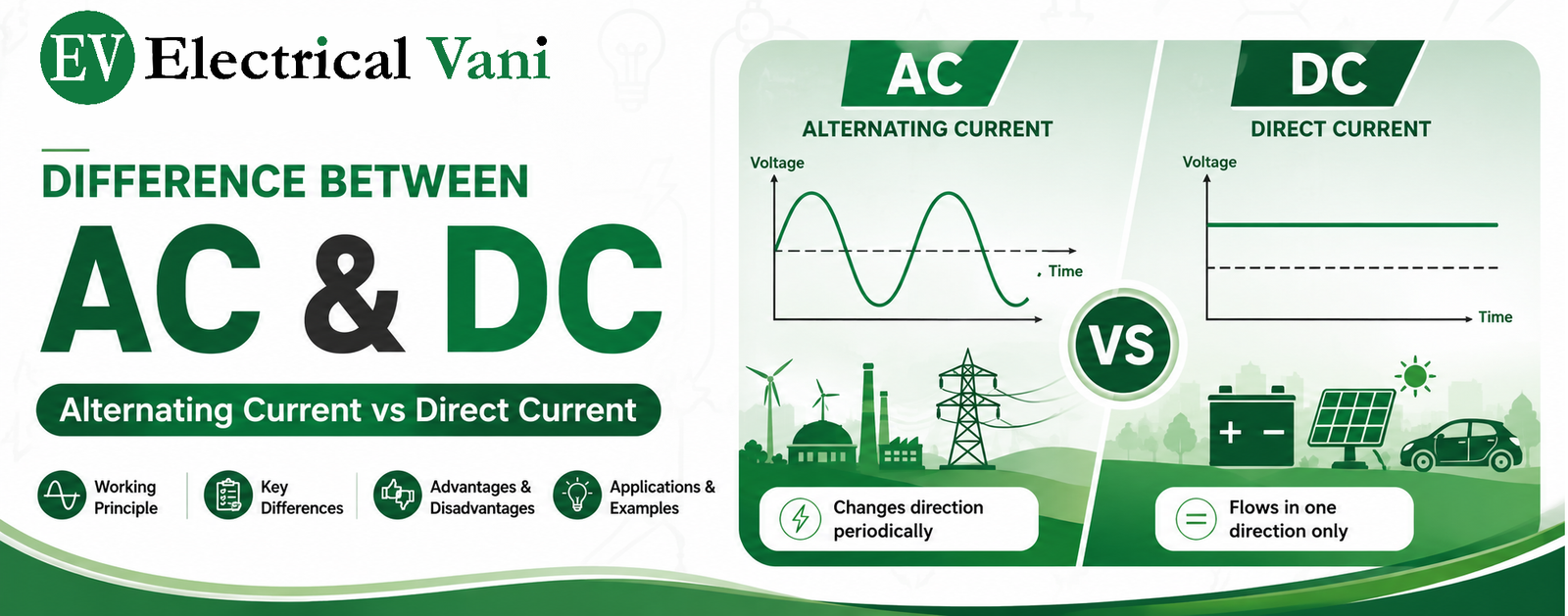
The following table provides a comparative study of alternating current (AC) and direct current (DC) –
| Parameter |
AC |
DC |
| Full Form | AC stands for Alternating Current. | DC stands for Direct Current. |
| Magnitude & Direction | AC changes magnitude continuously and direction periodically. | DC can have constant or varying magnitude but always flows in one direction. |
| Frequency | AC can have a frequency of 50 Hz or 60 Hz. | The frequency of DC is 0 Hz because it does not change its direction. |
| Waveform | AC that is used in practice has a sinusoidal waveform. | DC has a line either straight or any curved. |
| Movement of charge | In case of AC, electrons flow in forward and backward direction. | Electric charge in DC always moves in forward direction. |
| Voltage polarity | AC changes its voltage polarity continuously. | Voltage polarity of DC always remains the same. |
| Sources | Alternator and AC generator are examples of sources of alternating current. | Common sources of DC include battery, solar cell, DC power supply, etc. |
| Conversion | AC can be converted into DC using rectifier. | DC can be converted into AC using inverter. |
| Transformer Use | Transformers can be used to increase or decrease the voltage level of AC. | Transformers do not work with DC. Hence, electronic converters are used for voltage transformation. |
| Power Factor | Power factor for AC varies between 0 and 1. | Power factor for DC is always 1. |
| Load Type | AC works with all three types of loads i.e., resistive, inductive, capacitive. | DC works with resistive loads, because inductor and capacitor are frequency dependent loads. |
| Applications | AC is widely used in homes, industries, commercial buildings, etc. | DC is mainly used in electronics, batteries, EVs, solar systems, etc. |