In this chapter, we will study the major differences between utility-scale solar and rooftop solar. Hence, this chapter provides a comprehensive comparison of utility-scale solar and rooftop solar, i.e. Utility-Scale Solar Vs Rooftop Solar.
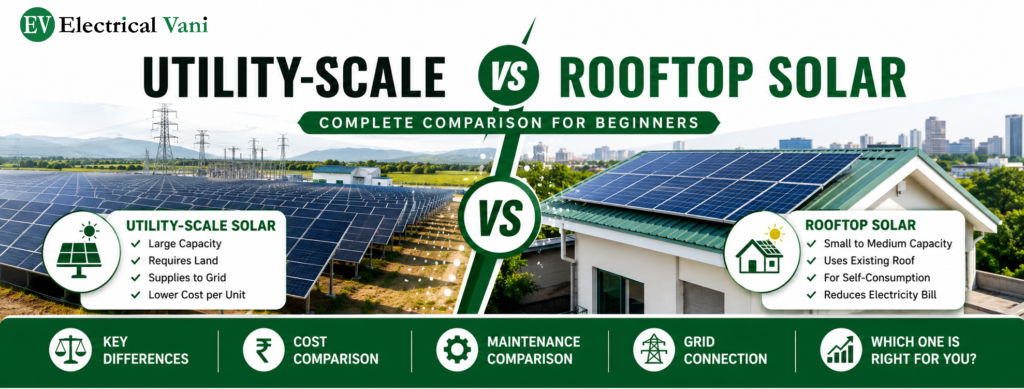
Utility-Scale Solar Vs Rooftop Solar
The following table highlights the key differences between utility-scale solar and rooftop solar –
| Parameter |
Utility-Scale Solar |
Rooftop Solar |
| Definition | A large solar power plant that generates electric power and supplies it to the utility grid. | A solar PV system installed on the roof of a building to fulfil its localized electricity demand. |
| Purpose | Generate large amounts of electric power for the grid. | Generate electric power for self-consumption and minimize electricity bills. |
| Installation Location | Utility scale solar is installed on large open land, deserts, barren land, or solar parks. | Rooftop solar is installed on the roofs of houses, commercial buildings, factories, schools, hospitals, etc. |
| Typical Capacity | Utility scale solar generally has 1 MW to several GW (Gigawatts) capacity. | Rooftop solar has capacity in the range of 1 kW to around 2 MW. Most commonly below 1 MW. |
| Electricity Consumer | Utility scale solar provides electricity to millions of consumers through the state or national grid. | Rooftop solar provides electricity to building owners or occupants. |
| Land Requirement | Utility scale solar requires large land area, approx. 4-5 acres per MW. | Rooftop solar does not require any additional land. |
| Power Flow | In utility-scale solar power flows as:
Solar Plant → Pooling Substation → Transmission Grid → Distribution Network → Consumers. |
In rooftop solar power flows as:
Solar Panels → Inverter → Building Circuit → Grid (if excess power is available). |
| Grid Connection Voltage | Typical grid connection voltages for utility-scale solar stations are 33 kV, 66 kV, 132 kV, 220 kV, or 400 kV. | Rooftop solar generally have voltage levels of 230 V, 415 V, or 11 kV for larger installations. |
| Type of Grid | Utility-scale solar is connected to transmission grid. | Rooftop solar is connected to distribution Network. |
| Main Equipment | PV Modules, SCB (String Combiner Box), String/Central Solar Inverters, IDT (Inverter Duty Transformer), RMU (Ring Main Unit), Pooling Substation, Switchyard, Protection System, SCADA, Transmission Line. | PV Modules, Mounting Structure (MMS), String Inverter, DCDB(DC Distribution Box), ACDB (AC Distribution Box), Net Meter, Earthing, Lightning Protection System. |
| Ownership | Government utilities, Independent Power Producers (IPPs), Private Developers, PSUs. | Homeowners, Commercial Establishments, Industries, Institutions, or RESCO (Renewable Energy Service Company) Developers. |
| Electricity Billing | Electricity is sold through Power Purchase Agreements (PPAs) or open access arrangements. | Electricity bills are reduced through self-consumption, Net Metering, Gross Metering, or Net Billing. |
| Transmission Losses | Utility-scale solar has higher transmission losses because electricity travels long distances. | In rooftop solar, transmission losses are very low because electricity is consumed near the point of generation. |
| Installation Time | Utility-scale solar requires several months to more than a year depending on project size. | Rooftop solar takes usually a few days to a few weeks. |
| Initial Investment | Utility-scale solar requires very high initial investment, around crores to thousands of crores of rupees. | Rooftop solar requires comparatively low initial investment. |
| Cost per Unit of Electricity | It has lower cost per unit due to economies of scale. | Rooftop solar has slightly higher cost of electricity than utility-scale still it provides savings on retail electricity bills. |
| Operation & Maintenance | Utility-scale solar requires dedicated O&M teams, SCADA monitoring, preventive maintenance, transformer testing, relay testing, vegetation control, and security. | Rooftop solar has simple maintenance such as panel cleaning, inverter inspection, cable checks, and performance monitoring. |
| Monitoring System | Utility-scale solar uses SCADA, Weather Monitoring Station, String Monitoring, CCTV, Remote Monitoring. | Rooftop solar uses Inverter Portal, Mobile App, or Basic Monitoring System. |
| Construction Complexity | Utility-scale solar has complex construction due to civil works, substations, transmission lines, and grid synchronization. | Rooftop solar installation is relatively simple and quick. |
| Environmental Impact | Utility-scale solar needs large land area and environmental clearances. | Rooftop solar has minimal environmental impact as it utilizes existing building roofs. |
| Scalability | Utility-scale solar is easy to scale by adding more land and equipment. | The scalability is limited in rooftop solar due to available roof space and structural capacity. |
| Government Support | Utility-scale supported through tenders, renewable energy policies, and PPAs. | Rooftop solar is supported through subsidies (where applicable), Net Metering policies, and consumer incentive schemes. |
| Suitability | Utility-scale solar is best suited for utilities, DISCOMs, renewable energy developers, governments, and large power producers. | Rooftop solar is best suited for residential, commercial, industrial, educational, and institutional consumers. |
| Main Advantage | Utility-scale solar generates a large amount of electricity at a low cost per unit. | Rooftop solar reduces electricity bills while making use of existing roof space. |
| Main Limitation | Utility-scale requires large land, high initial investment, and extensive infrastructure. | Rooftop solar has limited generation capacity due to roof area and shading constraints. |
| Real-World Examples | A 500 MW solar park supplying electricity to the state or national grid is an example of utility-scale solar. | A 5 kW rooftop solar system installed on a residential house is an example of rooftop solar. |