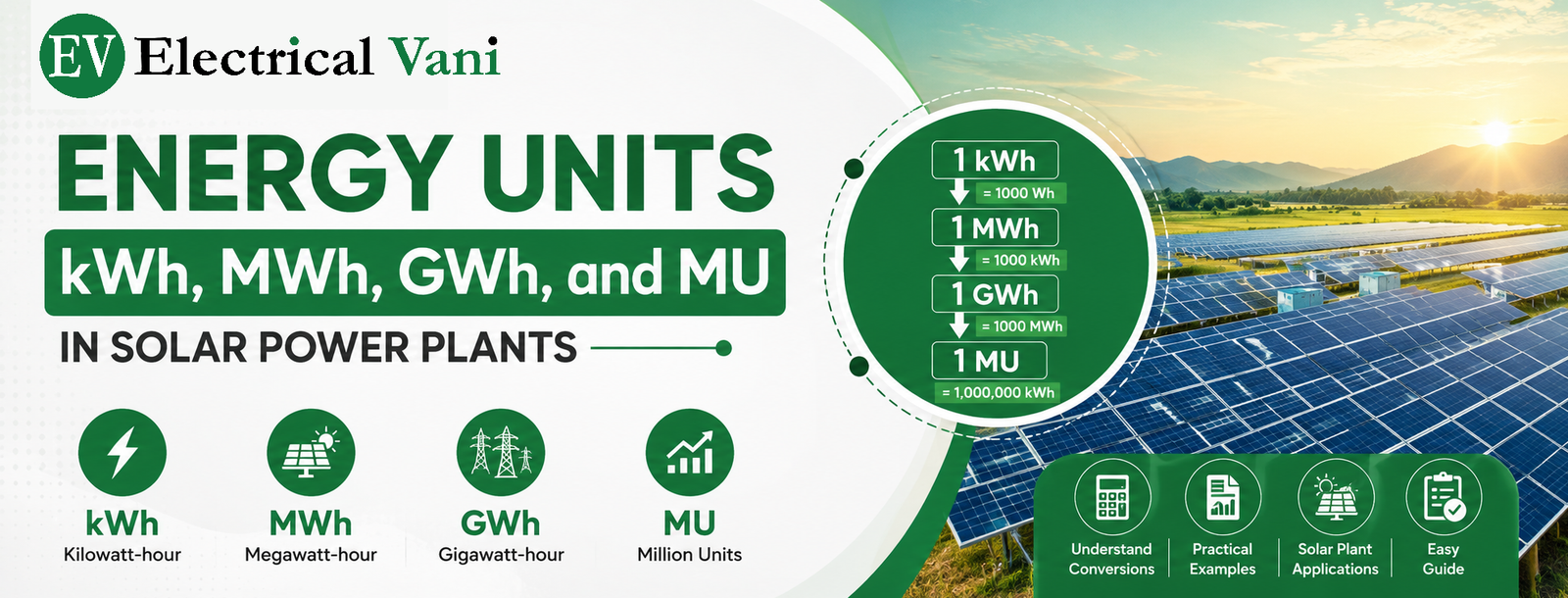
In this chapter, we will discuss different units of electricity measurement used in solar power plants. We will also understand how these energy units can be converted from one into another.
What is Energy?
Energy is the total amount of work done in an electrical system or circuit performed over a period.
In electrical systems, it is important to note that –
- Power is the measure of how fast electricity is being generated or consumed.
- Energy is the measure of how much electricity has been generated or consumed over a certain time.
Power Vs Energy
As a solar engineer, it is important to understand the difference between electric power and electrical energy as described below –
|
Power |
Energy |
| Power is instantaneous value. | Energy is accumulated value. |
| Power is measured in Watt, kW, MW, or GW. | Energy is measured in Wh, kWh, MWh, GWh, or MU. |
| Power indicates capacity of producing electricity. | Energy indicates actual generated or consumed electricity. |
| Power is similar speed of a car. | Energy is similar to total distance travelled by the car. |
Example
Let’s understand power and energy through an example.
Consider we have a water tank, then –
- Rate of Water Flow = Power
- Total Water Collected = Energy
In the same way,
For a solar inverter of 500 kW power rating –
Power = 500 kW, but when it is operated for 2 hours, the energy generated will be,
500 × 2 = 1000 kWh
What is kWh?
kWh (Kilowatt-hour) is the most basic unit of electricity measurement. It is also termed as Unit.
kWh means one kilowatt of power used continuously for one hour.
Example – A 3 kW rooftop solar system generates electricity for 7 hours, then
Energy Generated = 3 × 7 = 21 kWh or 21 Units
What is MWh?
MWh means Megawatt-hour. It is a larger unit of energy widely used in large solar plants.
1 MWh = 1000 kWh
Example – A 5 MW solar plant operates at full capacity for 6 hours, then
Energy Generated = 5 × 6 = 30 MWh = 30,000 kWh = 30,000 Units
What is GWh?
GWh means Gigawatt-hour. This unit of electricity is used for cumulative generation accounting of large solar power plants or parks, wind farms, and utility companies.
1 GWh = 1000 MWh = 1,000,000 kWh
What is MU?
MU is the most common unit of energy used in India. MU stands for Million Units.
1 Unit = 1 kWh
Therefore,
1 MU = 106 kWh = 1,000,000 kWh
Also,
1 MU = 1000 MWh = 1 GWh
Why is MU Used?
Government agencies, DISCOMs, NTPC, SECI, and other solar developers usually report their annual energy generation in MU because the numbers become easier to read and understand.
For example, saying 126,000,000 kWh is difficult, while same thing can be said as 126 MU.
Energy Unit Conversion Table
We can use the relations highlighted in the below table for easy conversion of energy units –
|
Unit |
Equivalent |
|
1000 Wh |
1 kWh = 1 Unit |
|
1000 kWh |
1 MWh |
|
1000 MWh |
1 GWh = 1 MU |
|
1 MU |
1,000,000 kWh |
Relationship Between kWh, MWh, and MU
Conversion between kWh and MU –
$$kWh \overset{\div 10^{6}}{\longrightarrow}\ MU$$
$$kWh \overset{\times 10^{6}}{\longleftarrow}\ MU$$
Conversion between MWh and MU –
$$MWh \overset{\div 1000}{\longrightarrow}\ MU$$
$$MWh \overset{\times 1000}{\longleftarrow}\ MU$$
Conversion between kWh and MWh –
$$kWh \overset{\div 1000}{\longrightarrow}\ MWh$$
$$kWh \overset{\times 1000}{\longleftarrow}\ MWh$$
Approximate Energy Generation of Solar Plants
The following table provides an approximate energy generated by different types of solar power plants –
| Solar Plant Size | Daily Generation (Approx.) | Annual Generation (Approx.) |
| 3 kW | 12 – 15 kWh | 4 – 5 MWh |
| 10 kW | 40 – 50 kWh | 15 – 18 MWh |
| 100 kW | 400 – 500 kWh | 150 – 180 MWh |
| 1 MW | 4 – 5 MWh | 1.5 – 2.0 GWh (≈1.5 – 2.0 MU) |
| 10 MW | 40 – 50 MWh | 15 – 20 GWh (≈15 – 20 MU) |
| 100 MW | 400 – 500 MWh | 150 – 200 GWh (≈150 – 200 MU) |
| 300 MW | 1200 – 1500 MWh | 450 – 600 GWh (≈450 – 600 MU) |
Note – Actual energy generation depends on solar irradiation, plant location, module technology, system losses, and Performance Ratio (PR).