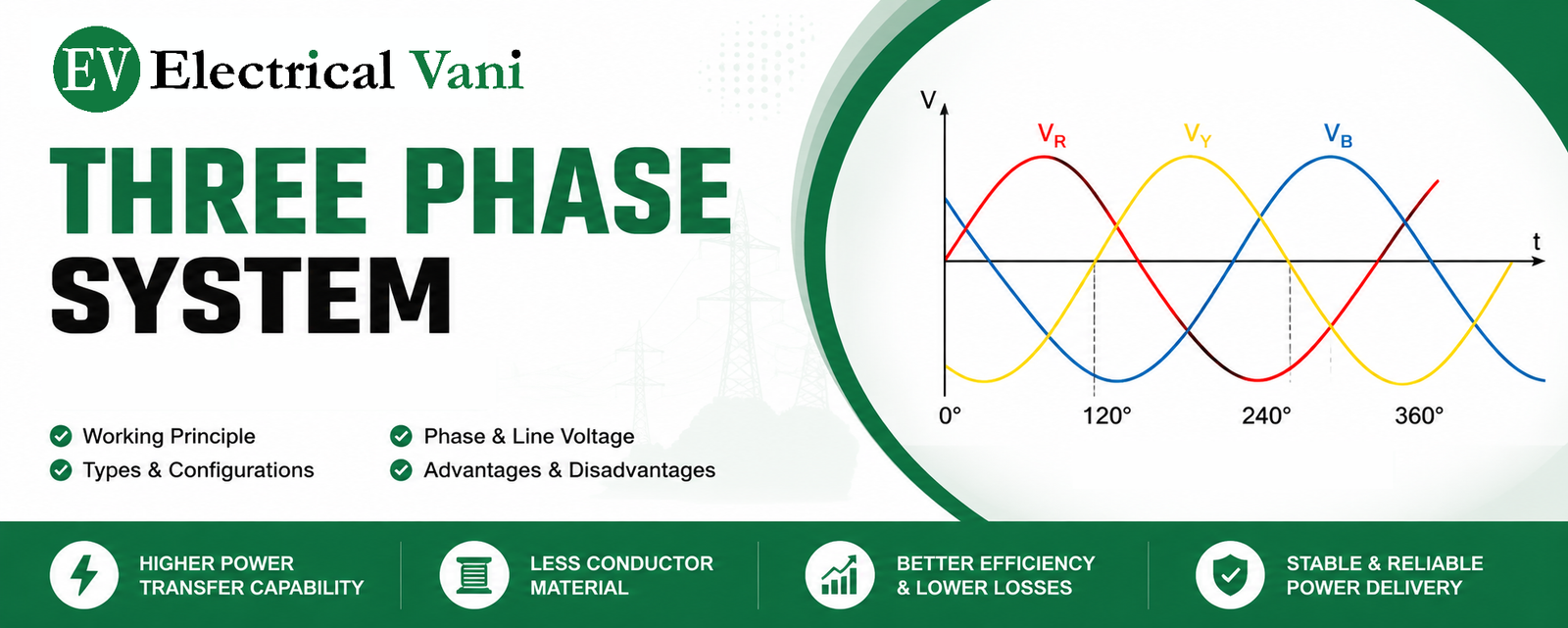
A three-phase system is an AC electrical system in which three sinusoidal voltages or currents of the same frequency are generated having a phase displacement of 120° electrical from one another. In the field of electrical engineering, three-phase systems are widely used for the generation, transmission, distribution, and utilization of electrical power because of several benefits such as better power transfer capability, higher efficiency, and smooth power delivery than single-phase power system. In this chapter, we will learn about the basics of three-phase system in electrical power system and its importance.
What is a Three-Phase System?
A three-phase system in electrical power system consists of three windings/phases which are represented as –
- Phase A or Phase R
- Phase B or Phase Y
- Phase C or Phase B
These three phases have the following characteristics –
- Equal frequency
- Equal magnitude, if the three-phase system is balanced
- 120° electrical phase displacement from each other.
For a balanced three-phase system, the phase voltages are expressed as –
$$V_R=V_m sinωt$$
$$V_Y=V_m sin(ωt-120°)$$
$$V_B=V_m sin(ωt+120°)$$
Where,
- Vm is the peak value of phase voltage
- ω is the angular frequency
- t is the time
Here, it is also important to note that the 120° electrical phase displacement is one of the key characteristics of a symmetrical 3-phase system.
Reason Behind 120° Electrical Phase Difference
One complete cycle of a sinusoidal alternating waveform represents an angle of 360°.
Since, in a 3-phase system, there are three equally displaced phases, hence,
$$\frac{360°}{3}=120°$$
Hence, the three phases are separated by 120° from each other.
Types of Three-Phase System
Three-phase systems based on phase displacement –
- Balanced Three-Phase System
- Unbalanced Three-Phase System
Three-phase systems based on number of wires used –
- Three-Phase Three Wire System
- Three-Phase Four Wire System
Balanced Three-Phase System:
A balanced three-phase system is one in which three-phase voltages have equal magnitudes and are displaced by exactly 120° electrical from each other.
Hence, for a balanced three-phase system, we have,
$$|V_R |=|V_Y |=|V_B |$$
Unbalanced Three-Phase System:
An unbalanced three-phase system is one in which three phase voltages are not equal in magnitude and phase angle.
In electrical power system, it is very important to understand unbalanced three-phase system because excessive voltage or current unbalance can result in the following consequences –
- Increased losses
- Unequal loading of equipment
- Heating of electrical equipment
- Protection related issues, and
- Poor power quality.
Three-Phase Three-Wire System:
A three-phase three-wire system has three phases namely –
- Phase R or Phase A
- Phase Y or Phase B
- Phase B or Phase C
No neutral conductor is available in this system.
Three-phase three-wire system is mainly used for balanced three-phase loads and in electrical transmission networks of medium and high voltage.
Three-Phase Four-Wire System:
A three-phase four-wire system consists of three-phases and one neutral, hence –
- Phase R or Phase A
- Phase Y or Phase B
- Phase B or Phase C
- Neutral (N)
This system is mainly used in low-voltage distribution networks to supply both three-phase and single-phase loads.
Phase Voltage and Line Voltage in Three-Phase System
There are two different voltages are associated with three-phase systems and they are –
- Phase Voltage (Vph)
- Line Voltage (VL)
Phase Voltage is the voltage measured between any one phase and neutral wire. While, Line Voltage is the voltage measured between any two phase wires of the three phase system.
Advantages of Three-Phase System
The following are some key benefits of three-phase system –
- Three-phase system has higher power transfer capability.
- It requires less conductor material.
- It has lower losses and hence better efficiency.
- It offers better and constant power delivery.
Disadvantages of Three-Phase System
Apart from advantages, three-phase system also has certain disadvantages which are given below –
- Three-phase systems require proper understanding of phase relationships, protection, grounding, and system configuration. Thus, they have complex designs.
- Switchgear, protection systems, transformers, metering, and other equipment may require more complex arrangements.
- Unbalanced loading can lead to unequal currents and additional losses.