In this chapter, we will understand Global and Indian Solar Market. As we know, today solar energy is not only an alternate source of electricity, instead it is becoming one of the main sources of global power sector. Every country is investing in developing solar power plants because they provide clean, renewable, affordable, and abundant electricity.
Twenty+ years ago, solar energy was considered an expensive source of electricity and used in special applications only such as space and remote areas. But today it has become the most economical source of power and being widely used from homes to schools, hospitals, railways, and large industrial applications.
India is also becoming one of the top growing countries in the world’s solar market. Due to several reasons such as abundant solar radiation, increasing electricity demand, declining solar equipment costs, and supportive government policies, solar energy is becoming India’s important electricity source for upcoming decades.
What is the Solar Market?
Solar Market can be defined as an ecosystem that involves generation of electricity from sunlight.
It includes components such as technologies, professionals, manufacturers, service providers, investors, government bodies, and consumers associated with solar energy.
Components of Solar Market
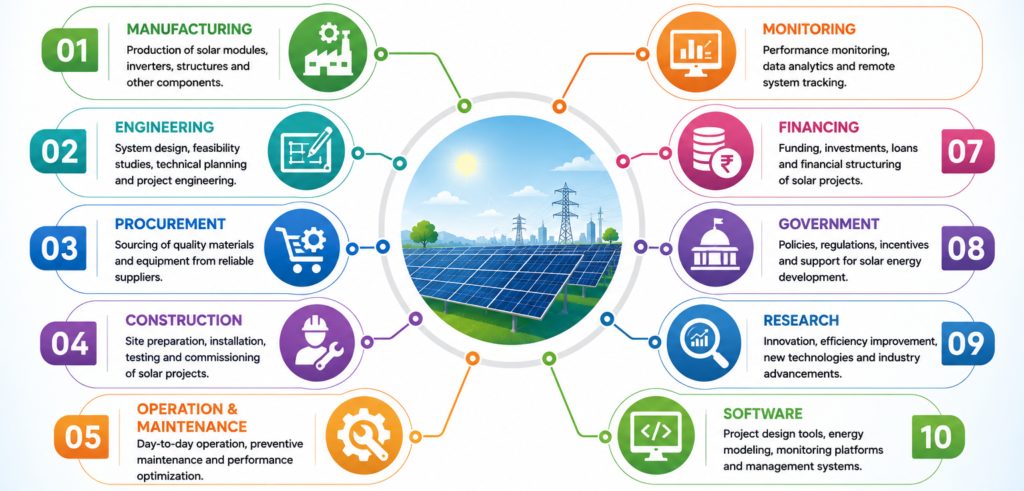
The solar market is much bigger, it comprises various components/sectors which are interlinked, and some of then are listed below –
| Component/Sector |
Example |
| Manufacturing | Solar panels, solar cells, solar inverters, MMS structures, solar cables |
| Engineering | Solar system design, electrical design, structural design |
| Procurement | Purchasing solar equipment |
| Construction | Installation and commissioning of solar equipment |
| Operation & Maintenance | Cleaning, inspection, fault analysis in solar plants |
| Monitoring | SCADA, Remote Monitoring Systems |
| Financing | Banks, investors, NBFCs (Non-Banking Financial Companies) |
| Government | MNRE (Ministry of New and Renewable Energy), State DISCOMs |
| Research | Universities, R&D organizations |
| Software | PVsyst, AutoCAD, ETAP, Helioscope, SCADA |
These sectors combinedly are creating millions of jobs worldwide.
Why is the World Shifting Towards Solar Energy?
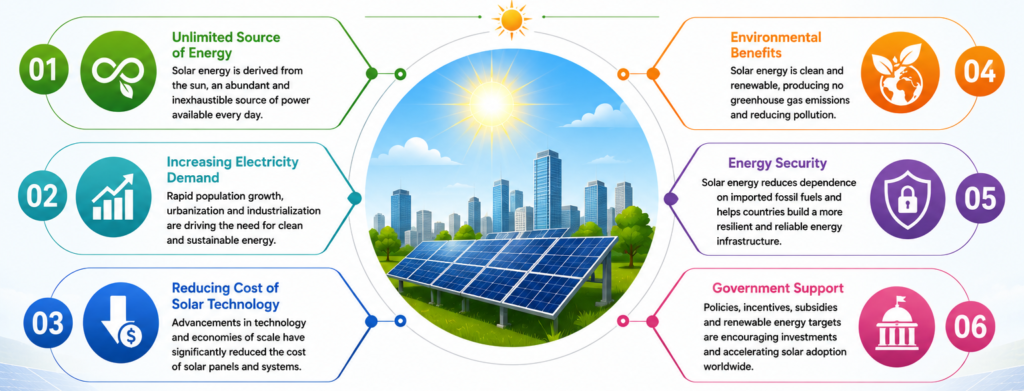
The following are some major factors driving the global transition towards the solar energy –
Unlimited Source of Energy
The Sun produces large amounts of energy every day, and it gets naturally replenished and will continue to be available for billions of years.
This key benefit makes solar energy one of the most sustainable energy resources available to humanity.
Increasing Electricity Demand
As electricity demand is growing every year, and the following are some possible reasons behind this –
- Population growth
- Urbanization
- Industrial expansion
- Inception of Electric vehicles, data centers, air conditioning, & digital infrastructure
With fossil fuels, it is very difficult to meet this growing demand of electricity, due to increased environmental impacts, fuel costs, and limited availability.
Reducing Cost of Solar Technology
Market research shows that another key reason behind solar energy’s growing adoption is due to significant drop in solar equipment costs over last twenty+ years.
As a result of this, many solar projects can generate electricity at competitive prices over their operating life span.
Environmental Benefits
Conventional power plants produce greenhouse gases and other environmental pollutants.
But solar power plants generate electricity without causing any direct environmental impact.
This feature of solar energy supports global efforts to reduce climate change.
Energy Security
Many countries are dependent on imported fossil fuels.
But solar energy allows those countries to produce electricity domestically. This helps them improve their energy independence and reduce exposure to fuel price fluctuations.
Government Support
Governments worldwide also promoting solar adoption through following –
- Renewable energy policies
- Competitive bidding
- Rooftop solar programs
- Manufacturing incentives
- Research funding
- Grid modernization
- Energy storage initiatives
All these policies have increased solar deployment across residential, commercial, industrial, and utility-scale sectors.
Evolution of the Global Solar Industry
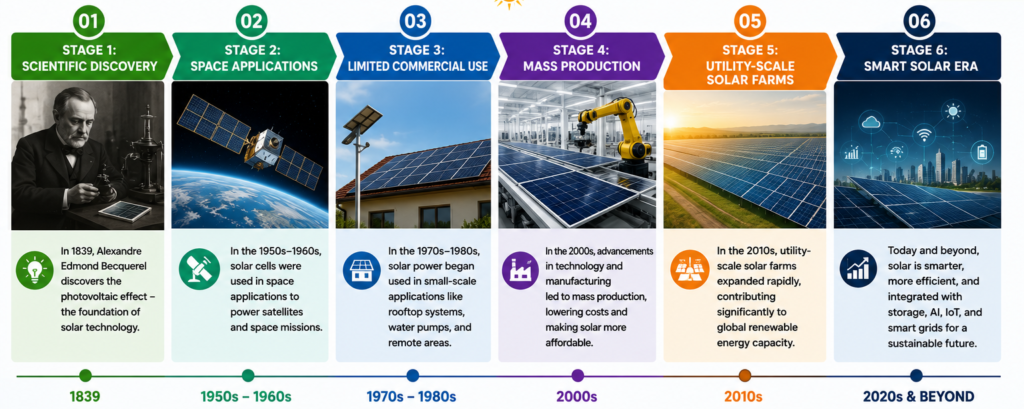
The global solar industry has evolved through many stages as discussed below –
Stage 1: Scientific Discovery
Scientists discovered that using certain semiconductor materials we can convert sunlight into electricity. This phenomenon today is known as the photovoltaic effect.
Stage 2: Space Applications
Initially, the commercial use of solar cells was in special applications only like satellites.
Stage 3: Limited Commercial Use
With improved manufacturing, solar systems were developed for supplying electricity to remote villages, communication towers, and off-grid locations.
Stage 4: Mass Production
Mass-scale manufacturing reduced costs and increased efficiency.
At this stage, solar panels became practical for residential, commercial, and industrial applications.
Stage 5: Utility-Scale Solar Farms
Most countries started installing their own solar power plants of capacity ranging from 1 MW to several GWs. These solar parks now supply electricity directly to national grids.
Stage 6: Smart Solar Era
The future of solar is not limited to generating electricity. But modern solar systems are integrating the followings –
- Battery Energy Storage Systems (BESS)
- Artificial Intelligence (AI)
- Smart inverters
- Digital monitoring
- Predictive maintenance
- Smart grids
- Electric vehicle charging infrastructure
Global Solar Market Introduction
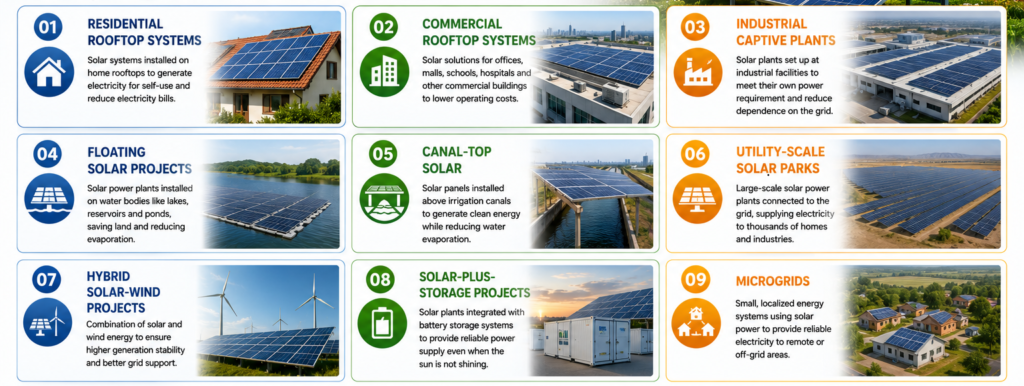
Today, solar energy has become a strategic part of producing electricity in many countries. This market includes –
- Residential rooftop systems
- Commercial rooftop systems
- Industrial captive plants
- Floating solar projects
- Canal-top solar
- Utility-scale solar parks
- Hybrid solar-wind projects
- Solar-plus-storage projects
- Microgrids
Major Solar Markets in World
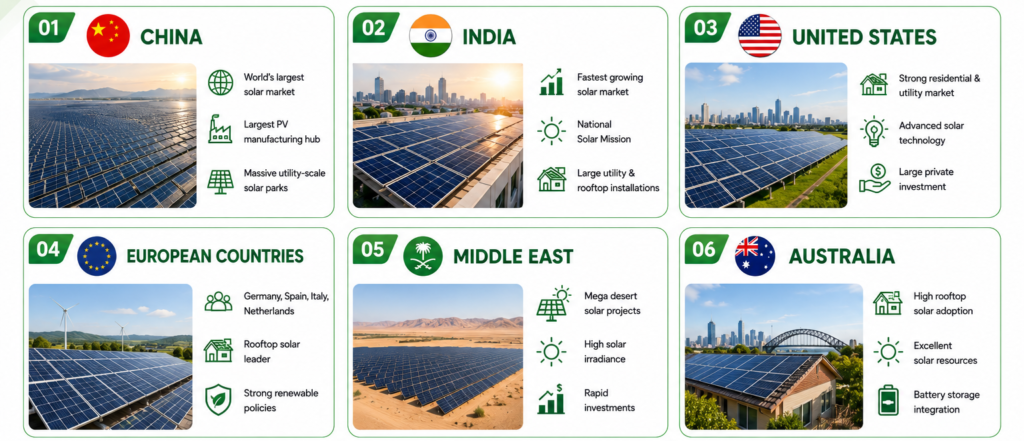
Many countries have developed rich solar industries because of supportive government policies, manufacturing capabilities, and growing electricity demand. Here is a snapshot of key solar markets in the world –
| Country |
Capability in Solar Market |
| China |
|
| India |
|
| United States |
|
| European Countries |
|
| Middle East |
|
| Australia |
|
Indian Solar Market Overview
Indian solar market has changed significantly over the past twenty+ years. These changes are briefly explained below –
Initially solar systems were mainly used for –
- Streetlights
- Water pumps
- Telecom towers
- Rural electrification
Today, India is developing –
- Large solar parks
- Floating solar projects
- Canal-top solar
- Hybrid renewable energy projects
- Solar-powered agriculture
- Rooftop solar for homes and businesses
- Solar systems integrated with battery storage
This rapid transition in solar market is mainly due to improvements in technology, affordability, and policy support.
Why India has High Solar Potential?
India has the following major natural and economic advantages justifying its high solar potential –
High Solar Radiation
Most parts of India receive abundant sunlight for much of the year. This makes solar generation practical across many regions.
Large Land Availability
Utility-scale solar projects can be developed in suitable geographical regions. While rooftop solar is installed for significant distributed generation.
Increased Electricity Demand
Economic development, urbanization, and electrification are increasing electricity consumption.
Government Support
Policies promoting renewable energy, manufacturing, transmission infrastructure, and distributed generation encourage long-term market growth.
Skilled Workforce
India has a large pool of engineers, technicians, electricians, and project managers capable of supporting industry expansion.
Major Segments of Indian Solar Market
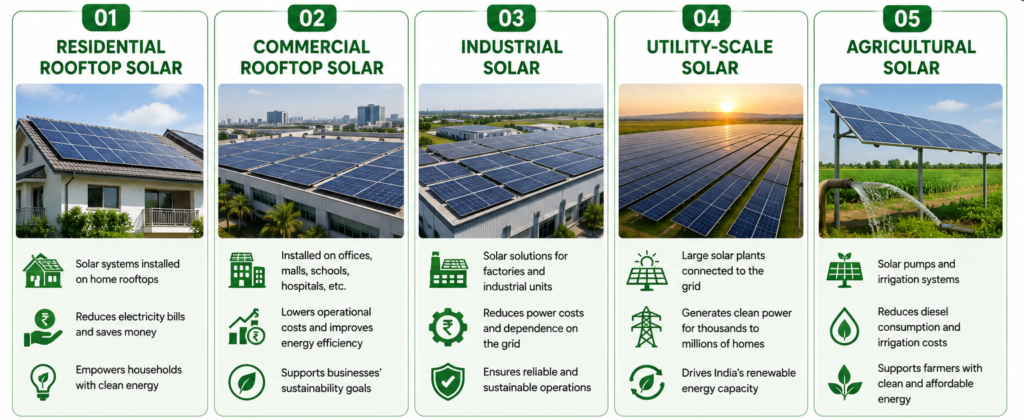
The following table provides an overview of major segments of Indian solar market –
| Solar Market Segment | Typical Capacity |
Description |
| Residential Rooftop Solar | 1 kW to 20 kW | Installed on homes to reduce electricity bills and improve energy independence. |
| Commercial Rooftop Solar | 20 kW to several hundred kilowatts | Installed on offices, schools, hospitals, shopping complexes, and institutions. |
| Industrial Solar
|
Several hundred kW to a few MW | Designed for factories and manufacturing units with high daytime electricity demand. |
| Utility-Scale Solar | Several megawatts to multiple gigawatts | Large solar power plants supply electricity directly to the grid. |
| Agricultural Solar | Few kilowatts | Includes solar-powered irrigation pumps and agricultural feeders, helping reduce dependence on conventional power sources. |
Challenges in Solar Industry
Despite rapid growth, the solar sector is facing multiple challenges, some key of them are listed below –
- Land acquisition
- Grid integration
- Energy storage requirements
- Weather variability
- Skilled manpower shortages
- Supply chain risks
- Recycling of end-of-life panels
- Financing for smaller projects
- Transmission infrastructure expansion
- Cybersecurity for digital systems
For long-term growth in solar sector, it is important to address all these challenges.
Future of Solar Energy
The upcoming 10-20 years is expected to see the following major developments in the field of solar energy –
- Continued expansion of utility-scale solar.
- Wider adoption of rooftop solar.
- Greater use of battery storage.
- Smarter grids capable of integrating variable renewable energy.
- Increased domestic manufacturing.
- Electrification of transport and industry.
- Integration of artificial intelligence into plant operations.
- Growth of green hydrogen supported by renewable energy.
- Expansion of floating and hybrid renewable projects.
Thus, solar energy is expected to become one of the primary components of the global electricity system, where India is playing an increasingly important role.